

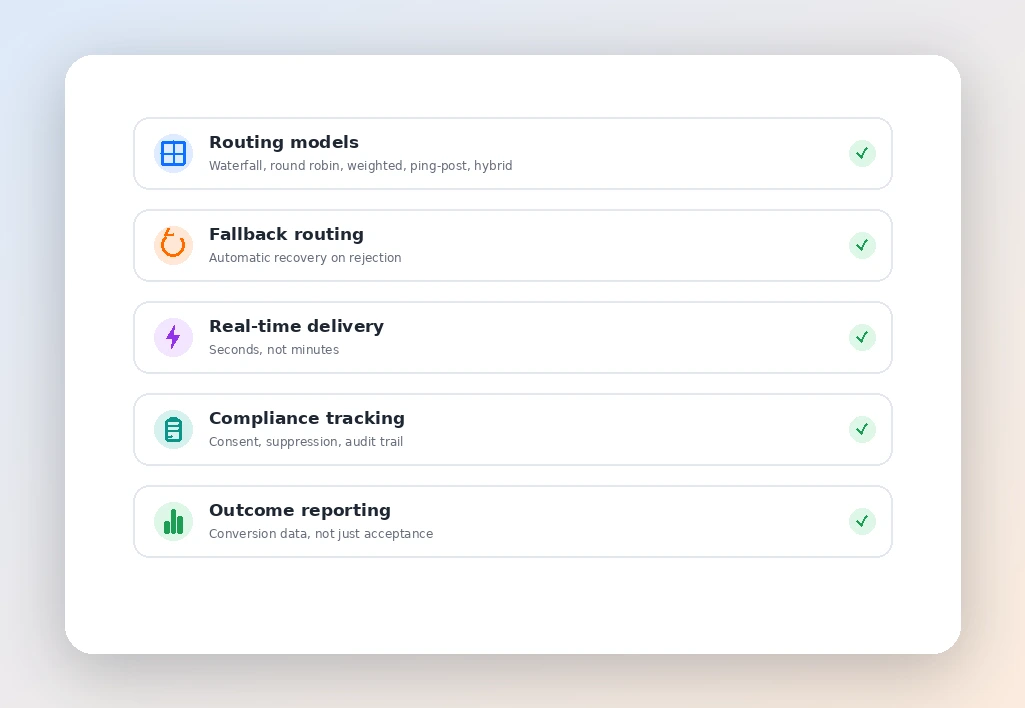
Lead distribution software ranges from simple webhook forwarders to full platforms with routing engines, buyer portals, and compliance tooling. The right choice depends entirely on your buyer mix and volume, but a few criteria matter regardless of scale. Here’s the checklist worth working through before committing to a platform.
Use this checklist alongside our hands-on lead distribution software comparison to move from requirements to a practical shortlist. If you want to check each criterion against a real platform, Vertikl’s lead distribution software page covers routing rules, ping post, retries, buyer outcomes and reporting point by point. The criteria about manual work map directly to its lead management automation software.
Routing Models Supported
Check which routing strategies the platform actually supports: waterfall, round robin, weighted, ping-post, and hybrid combinations of those. A platform that only offers one model (usually a simple waterfall) will force you into workarounds the moment your buyer mix outgrows it. You don’t need to use every model on day one, but the ceiling matters more than the floor here, since migrating routing logic between platforms later is disruptive.
Fallback Routing
This is the single feature most responsible for recovering revenue that would otherwise be lost, and also one of the most commonly missing or half-implemented features in basic tools. Confirm the platform supports automatic, real-time fallback chains, not just a static priority list with no path forward on rejection. Ask specifically: what happens, in this platform, when a buyer rejects a lead? If the honest answer is “it’s marked as rejected,” that’s a gap.
Real-Time Delivery Speed
Lead value decays by the minute. Ask for actual delivery latency numbers, not just “real-time” as a marketing term, ping-post and direct-post response times in seconds. This directly affects buyer conversion rates and therefore how much buyers are willing to pay for leads coming through the platform.
Buyer Eligibility and Caps
The platform should support per-buyer eligibility rules (geography, vertical, business hours, custom fields) and caps (daily, hourly, per-buyer) that are enforced automatically before a lead is ever routed, not after the fact. Manually managing eligibility exceptions outside the platform defeats the purpose of automating routing in the first place.
See these routing capabilities running on your own leads before you commit. Try Vertikl free for 14 days.
Compliance and Data Handling
Requirements vary by vertical, but check for: TCPA consent tracking if you’re in a phone-based vertical, suppression list checking against your own and buyers’ do-not-contact lists, and an audit trail showing exactly what data was sent to which buyer and when. This isn’t optional in regulated verticals, and it’s expensive to bolt on after the fact if the platform wasn’t built with it from the start.
Conversion and Outcome Tracking
A platform that only reports “delivered” and “accepted” is missing the metric that actually matters: did the lead convert. Look for support for buyer-reported outcomes (webhooks, status updates, periodic exports) feeding back into reporting, ideally into routing decisions too. Without this, you’re stuck optimizing for acceptance rate instead of revenue.
Integration Effort
Evaluate how leads get in (form integrations, ad platform connections like Google and Meta, API) and how they get out (buyer API delivery, webhook, CRM push). A platform that requires custom development work for every new lead source or buyer adds ongoing engineering cost that should be factored into the real price of the platform, not just the subscription fee.
Reporting and Visibility
You should be able to see, per source and per buyer: volume, acceptance rate, rejection rate, fallback recovery rate, and conversion rate, without needing to export data and build your own dashboard. If getting a clear read on “what’s actually happening in my pipeline” requires manual spreadsheet work every week, the platform is creating hidden operational cost.
Pricing Model Fit
Confirm pricing scales sensibly with your actual volume and buyer count, not just lead volume in isolation. A platform priced around a small buyer roster can get expensive fast if your model depends on many buyers each receiving smaller volumes, and vice versa.
Putting the Checklist to Use
Weight these criteria against your actual buyer mix rather than treating them as equally important across the board. An operation with one dominant buyer and simple fallback needs cares less about ping-post support than one running an auction across a dozen active buyers. What doesn’t vary: fallback routing, real-time delivery, and conversion tracking are foundational regardless of scale, because they’re the three things most responsible for the gap between “leads delivered” and “revenue earned.” If you want to see the criteria applied with weights to eight platforms, the review methodology and comparisons on our guides site use the same checklist.
Get routing, fallback, and buyer outcome tracking in one platform. Get started with Vertikl.
