

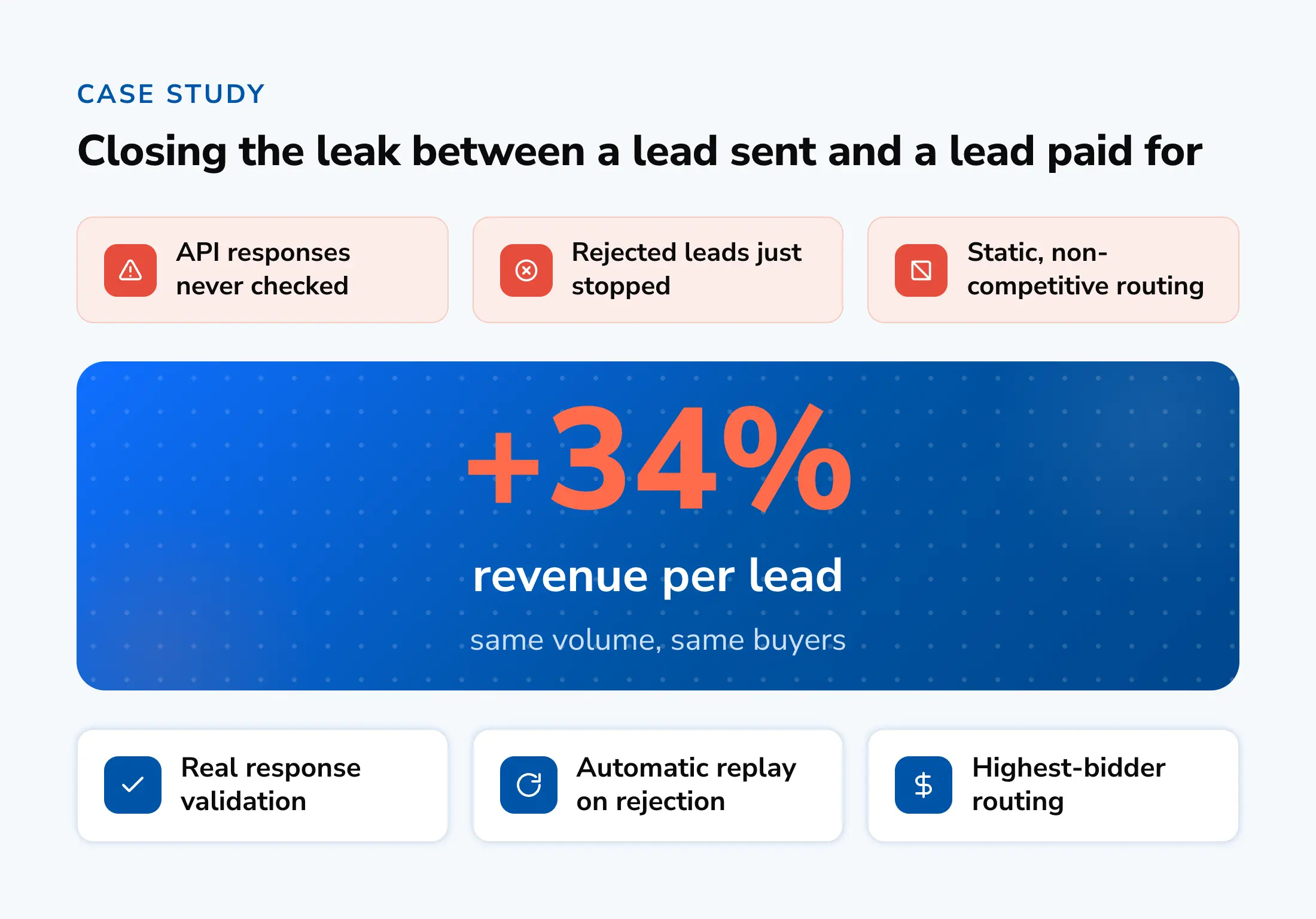
Most lead distribution setups don’t fail because of bad leads or a weak buyer list. They fail quietly, in the gap between “the lead was sent” and “the lead was actually paid for and worked.” One regional lead brokerage we worked with had exactly that gap, in three specific places, and closing them grew revenue per lead 34%, with far fewer leads lost along the way.
The same gaps are worth testing when you evaluate lead distribution platforms: a feature list matters less than what happens after a real buyer response. Tracing each gap back to the source that produced it ran through Vertikl’s lead source tracking.
The Setup
The brokerage was generating a healthy volume of leads across a handful of verticals and selling into a buyer network of a dozen or so accounts. On paper, the pipeline looked fine: leads went out, buyers received them, invoices went out at the end of the month. The problem wasn’t visible in any single dashboard, it only showed up as a gap between leads acquired and revenue actually collected.
Three specific blind spots were responsible for most of it.
1. API responses weren’t actually being checked
Leads were posted to buyer endpoints, and a response came back, but nothing in the pipeline read that response beyond confirming the request didn’t error out. A buyer’s API can return a technically successful response while rejecting the lead in the payload itself, wrong field, capacity reached mid-request, a compliance flag. Without parsing that response body, those leads were logged as delivered and counted toward revenue that was never actually going to arrive. The gap between “sent” and “accepted” was invisible until reconciliation, weeks later, by which point there was nothing left to do about it.
2. Rejected leads just stopped
When a buyer did reject a lead outright, there was no next step. No fallback buyer, no retry, no second attempt, the lead’s story ended at the first no. Since most rejections have nothing to do with lead quality (a buyer at cap, a filter mismatch, a timeout), a large share of those leads were still sellable, just not to that particular buyer at that particular moment. Every one of them represented cost already paid to acquire, and zero revenue recovered.
3. Delivery was static, not competitive
Leads were routed by fixed rule: this vertical goes to this buyer. It worked, in the sense that leads got delivered, but it meant every lead was sold to whichever buyer was first in line rather than whoever valued it most that day. Buyer demand and pricing shift constantly, a lead worth routing to Buyer A on Monday might be worth more to Buyer B by Wednesday. Static routing had no way to capture that difference, so leads were consistently sold below what the market would have actually paid.
See exactly what's happening to every lead after it's sent. Try Vertikl free for 14 days.
What Changed
None of the fixes required new lead sources or a new buyer network, the volume and the buyers stayed the same. What changed was what happened to each lead between capture and close:
- Real response validation. Every buyer API response is now parsed, not just checked for a successful status code, so a lead is only counted as sold when the buyer’s own response confirms it.
- Automatic replay on rejection. A lead rejected by one buyer is immediately routed to the next eligible buyer in real time, instead of the transaction simply ending.
- Real-time highest-bidder routing. Eligible buyers are pinged for each lead, and it’s posted to whoever’s willing to pay the most for it right then, instead of a fixed, static assignment.
The Result
With those three gaps closed on the same lead volume and the same buyer roster, revenue per lead grew 34%, and the share of leads lost to silent rejection or a single failed delivery attempt dropped sharply. None of it came from generating more leads, it came from recovering leads that were already being paid for instead of letting them leak out silently, and from making sure every lead that did sell went to whoever valued it most.
That 34% is one brokerage’s result on its own roster, not a number to expect by default. The size of the gain depends on how much was leaking before: a setup that already validates buyer responses and replays rejections has less to recover than this one did.
The pattern holds beyond this one case: if you can’t say with certainty what happened to every lead after it left your system, whether it was truly accepted, retried after a rejection, and sold at the best available price, there’s very likely revenue sitting in that uncertainty, and leads quietly going nowhere.
Stop guessing what happened after a lead was sent. Get started with Vertikl.
