

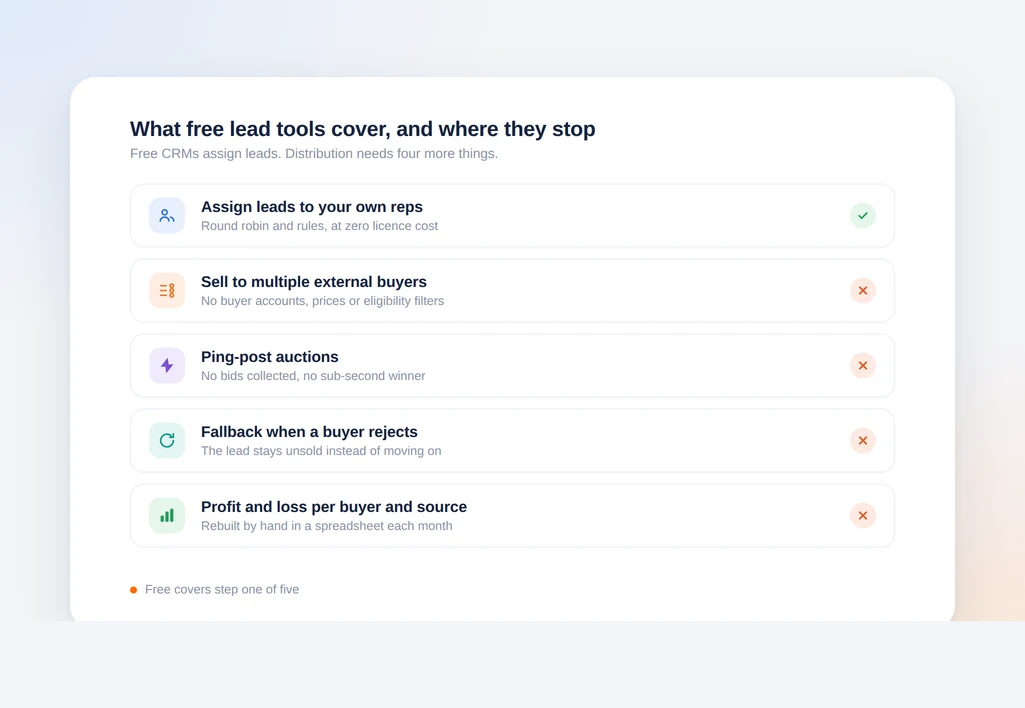
Free lead distribution software exists, but almost none of it distributes leads. The genuinely free options in 2026 (Mautic, EspoCRM, SuiteCRM, Odoo CRM’s one-app plan, and Bitrix24’s free tier) are CRMs and marketing automation tools that assign leads to people inside your own company. They do not sell leads to external buyers, run ping-post auctions, enforce buyer caps before delivery, or retry a lead that a buyer just rejected. If you route leads to five reps on your own sales floor, free is genuinely enough and you should not pay for a platform. If you sell leads to clients, free covers the first step of the job and leaves you doing the other five by hand.
Vertikl is not free. It starts at 300 euros a month. This article is not going to argue that free tools are bad, because for a large number of teams they are the right answer. It is going to show exactly where each free option stops, what “free” actually costs once you add hosting and labour, and the specific point at which paying returns more than it costs.
Last updated: September 2026.
Key Takeaways
- Free lead distribution software is almost always free lead management software. Assignment to internal reps is a solved problem at zero cost. Distribution to external buyers is not.
- Open source is free to licence, not free to run. A self-hosted CRM needs a server, backups, upgrades, and someone responsible for all three, which is where the real bill lands.
- Freemium plans cap on the axis you will hit first. Bitrix24’s free tier ships core CRM with 5 GB of storage and no workflow automation. Odoo’s One App Free is exactly one app, and the second one moves you onto per-user pricing.
- The DIY stack (Google Sheets plus Zapier) collapses fast: Zapier’s free plan allows 100 tasks a month and two-step Zaps, which is not enough for a single buyer feed with validation.
- The three things no free tool does are fallback on rejection, caps enforced before delivery, and per-buyer profitability. Those are also the three places lead sellers lose the most money.
- Vertikl costs 300 euros a month with a 14-day free trial. It is worth that only when you are selling real volume, which is the honest test to apply before switching.
What “Free” Actually Means in This Category
Three different things get called free, and they fail in three different ways.
Open source, self-hosted. Mautic, EspoCRM, and SuiteCRM cost nothing to licence. You provide the server, the upgrades, the backups, and the person who owns all of it. The software is free and the operation is not.
Freemium tiers. Bitrix24 and Odoo give you a real, usable product at zero cost, deliberately capped so that growth moves you onto a paid plan. Nothing wrong with that, but the cap tends to arrive sooner than the plan comparison page suggests.
The DIY stack. A form, a Google Sheet, and an automation tool stitched together. This is the most common starting point for small lead sellers and the one that produces the most invisible revenue leakage, because nothing in the chain knows what a buyer rejection is.
None of the three includes the parts of lead distribution that actually make money: an auction, a cap, a retry, and a per-buyer P&L. Worth reading alongside this: our buyer’s checklist for evaluating lead distribution software and the wider comparison of paid platforms.
Free vs Paid Lead Distribution Software Compared
“Free option” below means a genuinely usable no-cost tier, not a trial. Figures reflect published rates as of September 2026.
| Option | What it really does | Free tier | Real monthly cost | Sells leads to external buyers |
|---|---|---|---|---|
| Mautic | Capture, scoring, internal assignment | Yes, self-hosted | Hosting plus maintenance | No |
| EspoCRM | Lightweight CRM, team assignment | Yes, self-hosted | From ~10 to 30 € VPS | No |
| SuiteCRM | CRM with a deep workflow engine | Yes, self-hosted | Self-host, or ~£95 hosted | No |
| Odoo CRM | CRM with rule-based and round-robin assignment | Yes, one app only | 0 €, then ~$25 to $31 per user | No |
| Bitrix24 | CRM plus collaboration, rep assignment | Yes, capped | 0 €, then paid tiers | No |
| Sheets + Zapier | Manual routing with automation glue | Yes, 100 tasks/mo | 0 €, then ~$30+ | Partially, with no controls |
| Vertikl | Rule-based, priority, exclusive, shared, ping-post | No, 14-day trial | From 300 €, all features | Yes |
1. Mautic: Best Free Option for Capture and Scoring
Mautic is the most established open source marketing automation platform, and the strongest free choice if your lead problem is upstream of distribution. It captures leads from forms and landing pages, scores them against behaviour, segments them, and assigns an owner inside your own team. The source code is yours, so any custom field logic you need is achievable.
Where it stops: Mautic assigns leads inside your funnel. There is no buyer concept, no ping-post, no per-buyer cap, no delivery reconciliation, and no revenue reporting per destination. Teams that try to make it a distribution engine end up writing webhook handlers and cron jobs around it, which is real engineering work that never appears on the price comparison.
Best for: in-house marketing teams that want capture, nurture, and internal assignment without a licence fee and have someone comfortable running a PHP application.
2. EspoCRM: The Cheapest Self-Hosted Option to Run
EspoCRM is an open source CRM that is unusually light on resources, which matters more than it sounds when the bill is your own VPS. It handles contacts, leads, teams, and assignment cleanly, and it is the option most likely to run happily on a small server for years without attention.
Where it stops: the rule-based automation most routing scenarios need lives in a paid extension pack, so the free build gives you manual and team-level assignment rather than a routing engine. There is no ping-post, no buyer caps, and no outcome reporting across buyers.
Best for: small teams that want a free, low-maintenance CRM and assign leads to a handful of internal reps.
3. SuiteCRM: The Deepest Free Workflow Engine
SuiteCRM is the open source fork of SugarCRM and carries the most capable workflow module of the free CRMs here. With patience, you can build conditional assignment logic that approximates simple routing rules, and the community around it is large enough that most problems have been solved publicly.
Where it stops: it is a CRM workflow engine, not a real-time routing engine. Delivery to a buyer’s API, ping-post bidding, caps checked before a lead is sent, and automatic retry on rejection are all outside what it does. Self-hosting is free; the managed OnDemand hosting starts around £95 a month, at which point you are paying for hosting rather than distribution.
Best for: operations that already run SuiteCRM and want to squeeze internal assignment logic out of it before buying anything.
4. Odoo CRM: Real Rule-Based Assignment, One App Deep
Odoo CRM has the best assignment logic of the freemium options: lead scoring, round-robin distribution, and rule-based routing to sales teams, on a One App Free plan with unlimited users. For an in-house sales floor, that combination at zero licence cost is genuinely hard to beat.
Where it stops: One App Free means one app. Add a second module and you move onto per-user pricing that lands roughly in the $25 to $31 per user per month range on the US list, which scales with headcount rather than lead volume. The routing itself targets internal sales teams, so there is no buyer portal, no ping-post, and no revenue reconciliation across external buyers.
Best for: internal sales teams that want round-robin and rule-based assignment for free and are happy staying inside one Odoo app.
5. Bitrix24: Free CRM With Routing Attached to Collaboration
Bitrix24 is the best-known freemium CRM with lead assignment built in, bundled with tasks, chat, and document management. For a small team that wants one free system for both CRM and collaboration, the free tier delivers real value.
Where it stops: the free plan is core CRM only, with 5 GB of storage and no workflow automation, and search behaviour degrades once a category holds more than about a thousand records. Distribution logic is built around assigning leads to internal reps, not selling them to buyers with filters, caps, and revenue share. Automation and higher limits move you onto paid tiers.
Best for: small in-house teams that want free CRM plus collaboration and assign leads internally.
Selling leads rather than assigning them? See what a real routing engine does with your own lead flow. Start a 14-day free trial.
6. The DIY Stack: Google Sheets Plus Zapier
This is the honest baseline most small lead sellers actually run: a form writes to a Google Sheet, an automation tool forwards rows to buyers, and someone watches it. It costs nothing to start and it works, right up until it does not.
Where it stops: Zapier’s free plan allows 100 tasks a month and limits Zaps to two steps, one trigger and one action. A single buyer feed with validation, a duplicate check, and a delivery step already exceeds that. More importantly, nothing in this stack knows what a rejection is: when a buyer returns an error or refuses a lead, the row stays in the sheet and the revenue quietly disappears. There are no caps, no auction, no audit trail, and no way to answer “which buyer was profitable last month” without building a report by hand.
Best for: proving a lead business exists. Not for running one past a few hundred leads a month.
What Free Actually Costs
The subscription line is the cheapest part of a lead operation to measure and the least useful to optimise. Three costs sit underneath it.
| Hidden cost | Where it shows up | Typical size |
|---|---|---|
| Infrastructure | VPS, backups, offsite copies, TLS and DNS | ~10 to 30 € a month small, 40 to 150 € at scale |
| Maintenance labour | Upgrades, patches, broken feeds, new buyer integrations | A few hours a month, every month |
| Unretried rejections | Leads a buyer refused that nobody re-sold | The largest line, and the least visible |
Run the third one against real numbers. An agency selling 2,000 leads a month at 18 euros each turns over 36,000 euros. If 8% of those leads are rejected by the first buyer and nothing automatically offers them to the next eligible one, that is 160 leads and roughly 2,880 euros a month written off. A platform at 300 euros a month has to recover about one lead in ten of those to pay for itself. That is the actual arithmetic behind the upgrade decision, and it is why we wrote separately about where lead revenue leaks and how fallback routing recovers it.
Five Signals You Have Outgrown Free
- You sell to more than two or three external buyers. Every buyer added multiplies the eligibility rules someone has to apply by hand.
- Caps and schedules are enforced after the fact. If a buyer’s daily cap is something you notice at 6pm rather than something the system refuses at lead 201, you are paying for it in credits and in trust.
- Rejected leads are written off. This is the single clearest signal, and the easiest to price, using the arithmetic above.
- Month-end reconciliation involves a spreadsheet. If nobody can say which source and which buyer made money last month without rebuilding it by hand, routing decisions are being made blind.
- You are in a consent-sensitive vertical. Consent capture, suppression checks, and an audit trail of exactly what was sent to whom are not features you bolt on after a complaint arrives.
When Free Is Still the Right Answer
We would rather you not pay us than pay us for the wrong reason. Stay on free tooling if you assign leads to your own reps rather than selling them, if your volume sits comfortably under a few hundred leads a month, if one buyer takes essentially everything you produce, or if you have in-house engineering capacity and a genuine reason to own the stack. In each of those cases a free CRM plus a clear process beats a subscription, and the difference goes into media spend where it earns more.
How to Move Off Free Without Breaking Your Buyer Feeds
The migration that goes badly is the one done all at once. The one that goes well is boring:
- Document the routing rules that currently live in someone’s head. Which buyer takes which geography, at what cap, at what price, and what happens when they say no.
- Move one buyer first. Keep the rest on the old process and run both for a week.
- Compare acceptance and delivery time between the migrated feed and the manual one. This is where the difference usually shows up first.
- Turn on fallback before you move the rest, so rejections start getting re-sold while volume is still small enough to watch.
- Only then migrate the remaining buyers, and retire the spreadsheet rather than leaving it running in parallel.
If you want the numbers for your own volume before deciding, the cost calculator prices it against your actual lead count, and the lead distribution guide covers the routing models in plain terms.
Conclusion
Free lead distribution software is real, and mostly mislabelled. Mautic, EspoCRM, SuiteCRM, Odoo CRM, and Bitrix24 are good free tools for capturing leads and assigning them to people who work for you. Not one of them sells a lead, runs an auction, enforces a cap before delivery, retries a rejection, or tells you which buyer made you money. Those five things are the job when you distribute leads commercially, and no amount of configuration turns a CRM into an engine that does them.
Vertikl costs 300 euros a month, includes every feature at every tier, and is worth paying for at exactly one point: when the leads you are not re-selling, the caps you are policing by hand, and the reports you are rebuilding every month add up to more than that. Below that line, stay free. Above it, the free tool is the expensive one.
Run your real lead flow through routing, fallback, and buyer reporting before you pay anything. Try Vertikl free for 14 days.