

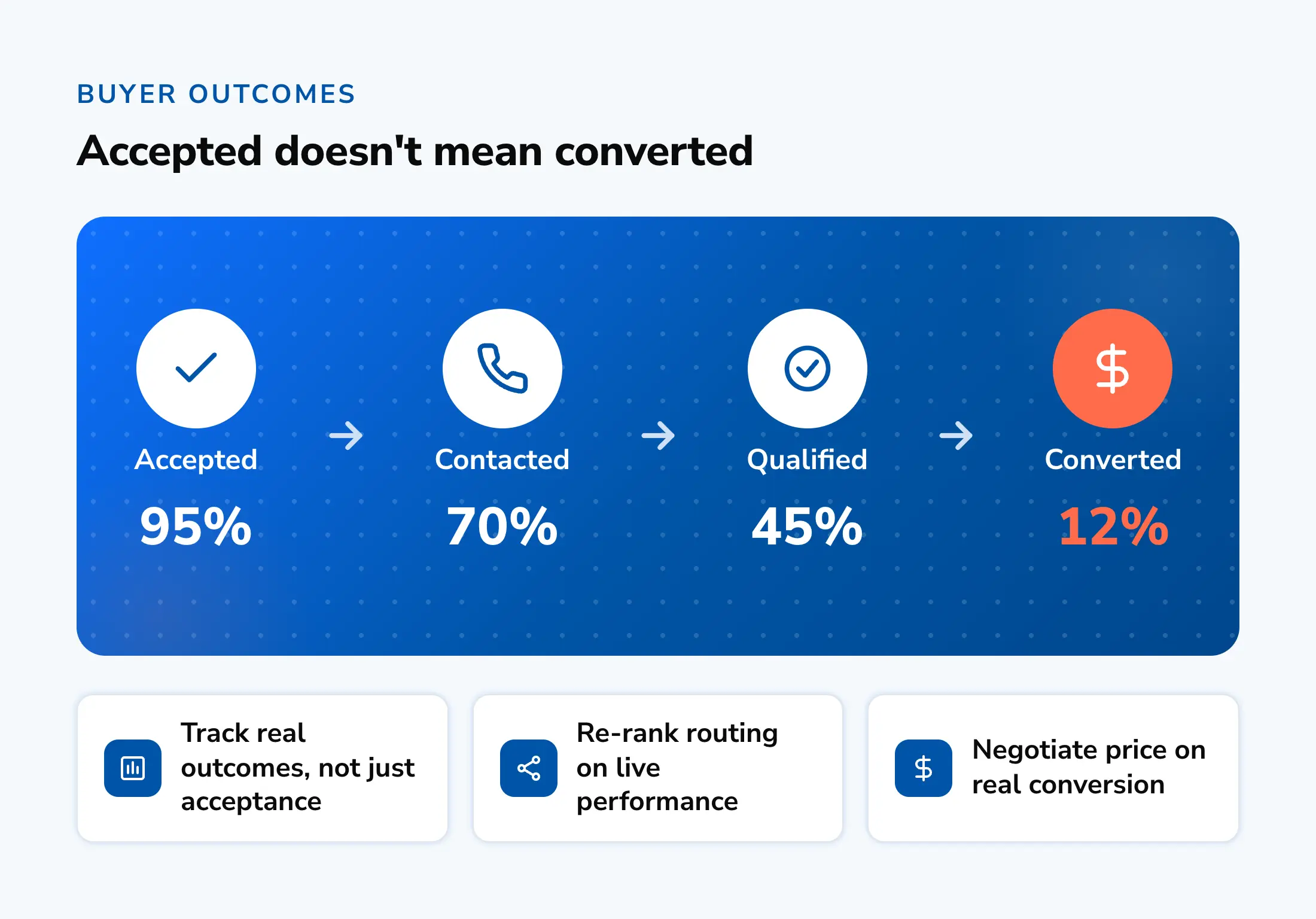
A buyer accepts a lead. On a delivery dashboard, that looks like a win. But acceptance only means the buyer’s system took the record, it says nothing about whether their sales team actually reached the prospect, qualified them, or closed anything. Lead distributors who only track acceptance rate are optimizing for the wrong number, and buyer outcome tracking is how you close that gap.
For a broader view of the tools that connect delivery data to revenue, compare the best lead distribution platforms and check which ones return buyer outcomes to the routing engine. Vertikl’s lead distribution software tracks contacted, qualified, converted, lost, invalid, duplicate and unreachable outcomes per buyer, source and campaign. Its lead conversion tracking software page shows how each outcome feeds back into routing decisions and per-buyer revenue.
Acceptance Measures Delivery, Not Revenue
Acceptance rate answers one narrow question: did the lead match the buyer’s intake filters closely enough for their system to take it? It says nothing about:
- Whether the buyer’s team actually contacted the prospect
- Whether the prospect was qualified once contacted
- Whether the deal closed, and for how much
- Whether the buyer would have paid more (or less) for a lead like this one
A buyer can accept 95% of the leads they receive and convert almost none of them, if their sales process is slow, their follow-up is weak, or the lead simply wasn’t the right fit despite passing their intake filters. On an acceptance-only dashboard, that buyer looks great. On a revenue dashboard, they’re actively hurting your business, because every lead routed to them instead of a buyer who converts is lost revenue.
What Buyer Outcome Tracking Actually Requires
Getting real outcome data means capturing what happens to a lead after delivery and acceptance, fed back from the buyer’s side:
- Contacted: did the buyer’s team actually reach the prospect
- Qualified: did the prospect meet the buyer’s real criteria on human review, not just the automated filter
- Converted: did the lead become a sale, signed deal, or booked appointment
- Return/dispute: did the buyer flag the lead as bad after the fact, and why
This data has to come from the buyer, which means it depends on some kind of reporting mechanism: a webhook the buyer’s CRM fires on status change, a periodic export, or at minimum a manual status update on a shared portal. Buyers who won’t share any outcome data at all are a real signal, it’s much harder to route to them intelligently over time if the only thing you ever learn is “delivered.”
Track buyer outcomes alongside delivery and acceptance in one place. Try Vertikl free for 14 days.
Turning Outcomes Into Routing Decisions
Outcome data is only useful if it feeds back into how leads get routed. A few concrete ways it should change routing:
Re-ranking waterfall priority. A buyer sitting at the top of a priority list because of a relationship or a legacy assumption should get bumped down if their conversion rate has quietly declined, and a buyer converting well should move up, regardless of how long they’ve been in the roster.
Adjusting weighted distribution. Weights should track a real, current performance metric, not a number set once when the buyer relationship started. If conversion rate is the metric, weights should shift as conversion rate shifts.
Setting a floor for staying in the pool. Buyers whose conversion rate falls below a threshold, even with a high acceptance rate, are candidates for removal or a much smaller allocation. Without outcome tracking, this kind of buyer can persist indefinitely because nothing about their acceptance behavior looks wrong.
Informing price negotiations. A buyer converting leads at a high rate has room to be asked for a higher price. A buyer converting poorly has much less leverage to demand priority placement, even if they’ve historically had it.
The Cost of Not Tracking Outcomes
Without outcome data, a distribution operation is flying on partial instruments: it knows what was delivered and what was accepted, and nothing about what actually happened next. That’s enough to catch some problems (a buyer rejecting everything is obviously not a good match) but it misses the more common and more expensive failure mode, a buyer who accepts everything and quietly converts very little of it. Closing that visibility gap is usually the single highest-leverage change a distribution operation can make, because it turns “which buyer should get this lead” from a guess based on relationship and history into a decision based on actual, current performance.
Route based on real conversion outcomes, not just acceptance. Get started with Vertikl.
